|
School Band
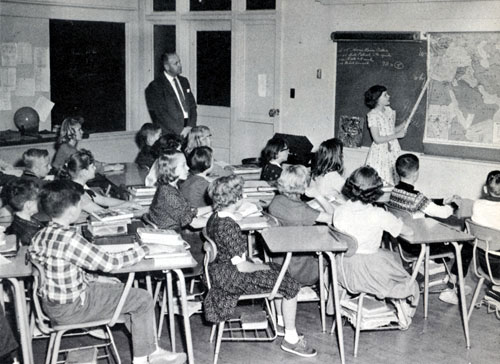
Early in June of
1962 while sitting very unprepared for surprise quiz in Mr.
Peterson's sixth grade geography class, Walter Nechoda burst into
the class room. He announced that anyone who wanted to be in
the school band next year needed to come immediately to the band
room. I instantly decided my fate would be better up in the
band room rather than suffer Mr. Peterson's geography test.
Greatly relieved, I
was off the hook with Mr. Peterson but now subject to the heavy rule
of band director, Walter Nechoda who had a reputation of demanding strict obedience
with a fiery temper. Legend has it that one time he hurled a music
stand over the heads of the entire school band when provoked to
anger.
Mr. Nechoda’s
assistant director, fresh out of college Jerry Shipton, distributed
plain 3” x 5” cards on which we were instructed to write our names
and three musical instruments we’d like to play in order of
preference.
Having never before
thought of playing a musical instrument in the school band, I chose
drums as first choice figuring that might be easiest, and trumpet as
second choice because that seemed to me cool. I left third
choice blank as I had no idea.
We where given a
battery of tests of tone, scale, and rhythm to evaluate our musical
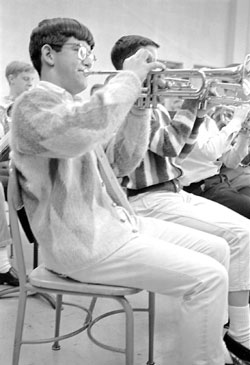
abilities. The following school year Scot played trumpet and I
played drums in the Junior High band.
The first day
of band in my seventh grade year at Hinsdale Junior High I knew Mr. Nechoda had a difficult job. The band room was
full of about a hundred 12 year olds. Only a few of the
kids had ever played a musical instrument before. I couldn’t
imagine how Mr. Nechoda was going to transform us into band that
could actually play music. I don’t know what it was like for the
others because all 14 of us drummers were quickly relegated to a
smaller room accompanied by Jerry Shipton, the new assistant band
director. It was his first day too.
Though he had
recently graduated from college with a degree in band instruction I
got the impression that Mr. Shipton was more nervous than we were. There were three large folding tables set up in a U shape. Mr. Shipton stood in the middle and showed us how to properly hold our
2B drum sticks. Then he instructed us to beat the table in a simple
left right pattern.
The sound of
fourteen 12 year old wannabe drummers struggling to slowly beat left right
left right left right in unison surely sounded crudely imperfect to
Mr. Shipton but to me the sound was magical. Goose bumps flooded my
arms as I participated in the simple cadence. The sound of drummers
playing together thrilled me and that very moment I determined to
become a great drummer.
A few of the
other drummers had already taken private lessons and
knew some of the basic rudiments. Fourteen drummers was twice
the number the band
required. Soon there would be a cut and some of the
drummers moved over to other instruments the band was short on.
Within a few weeks we were offered the option of playing bass violin
in the orchestra or tuba in the band. I didn’t want to play
either. In two weeks there would be the big challenge and seven
drummers would be cut. I only wanted to play drums and worried that
I wouldn’t make the cut so I practiced as best I could.
The big day
arrived. With the entire band was assembled together in the band room, from
our position in the rear, each drummer took his turn playing certain rudiments
as all ears listened and all eyes watched. Only the seven best drummers would
remain. Mr. Nechoda announced the names of the seven to
stay...
though in seventh place, I would remain a drummer. I became even more
determined to be a great drummer.
My parents apparently recognized
that I was serious and in the second semester, paid for weekly
private lessons. Hal Dean was my instructor. He was a
life long professional drummer who played with jazz bands in the evenings. I
looked forward to those half hour sessions of private instruction
with Mr. Dean. Private lessons with Mr. Dean was my first up
close and personal exposure to a professional musician.
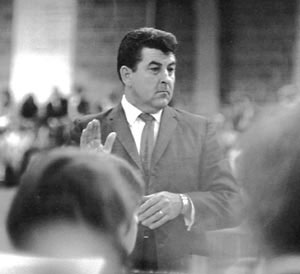
The Hinsdale
School bands and orchestras were highly regarded having won many
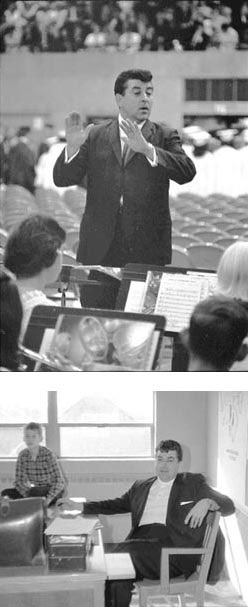
state championships producing many career musicians. Mr. Nechoda was a severe task master requiring strict obedience and all
eyes attentive to his. He was mesmerizing in his power often
holding our gaze for long minutes of silence before his baton would
strike a downbeat.
The intensity of Mr. Nechoda’s direction taught
me of the great value he placed on the final result. Though yet
foreign to me at 12 years old I envied his passion. Seeds of
excellence were gratefully sowed into my young sprit by his powerful
presence.
The seating
order in band or orchestra is determined in order of skill with
first chair being the best, second chair the next best, etc. I was
last chair. I practiced regularly challenged by the desire to
excel and also to please Mr. Dean who seemed to take a personal
interest in teaching me.
Without prior notice,
Mr. Nechoda declared a challenge right on the spot to determine the
seating order of the drummers. Being last chair I was the last
one to play the required rudiments. Though I had been practicing diligently I had no serious
aspiration of advancing beyond the drummers ahead of me who seemed
much more accomplished than me. Without thinking too much
about it I simply played as requested and executed the rudiment
confidently with surprising precision.
Mr. Nechoda was
apparently impressed with my performance as he immediately moved me
from last chair to first chair! I was stunned as were the other
drummers. I proudly held first chair throughout my school
experience blessed to have been greatly influenced by Walter Nechoda
and Mr. Dean.
I grew up in a
music loving household and my sisters and I were exposed to a wide variety
of music. As a family, we saw all of the great musicals of
the 50’s and early 60’s such as Oklahoma, Annie Get Your Gun, Gigi,
My Fair Lady, South Pacific, West Side Story, and The Music Man.
Then we’d get the albums and play them over and over. Dad would
often come home from work with the latest Chuck Berry record. Mom
always had her kitchen radio tuned to WFMT, Chicago’s classical
radio station. My sisters and I had our own radios
always tuned in to WLS
for all the top 40’s hits.
When I joined
the school band I brought along an appreciation for a broad range
of music. At 12 years of age when I started band, my ears were yet
unsophisticated when it came to how music was made. For the first
couple of months of band, each section was relegated to
individual rehearsal rooms to learn the basic fundamentals of how to
play their instruments and read music.
When it was
finally time to bring the entire band together I naively thought
that every instrument simply played the same melody and the drums
added the rhythm. I was amazed and enraptured as Mr. Nechoda had
each section play their part while the other sections were quiet.
Right then and there my appreciation for music took a quantum leap
forward. I was that much more amazed by the infinite
complexity, diversity, of music and by how each part supported the others in
melody, harmony, and rhythm.
Prior to that
moment, I had heard music only as the sum of it’s parts. Now my
ears were being trained to recognize each contributing component.
It was a glorious revelation to my young ears. From that day forth
my love for music grew with my ears trained to identify and
appreciate each component part as well as the entire result.
Band was first
period in high school which was a great way to start the day I
thought... until my first day. What I wasn’t prepared for was marching
band practice outside in the cold and often damp Fall mornings. I
always wondered how the marching band ever learned to play and march
in step with intricately choreographed moves they performed at
football game half time. Learning the music was a breeze. Turning
here and there, marching diagonally, counting steps and playing at
the same time seemed to require supernatural ability.
The first
morning marching practice was hysterical. The sun had barely
just dawned, it was cold, the grass was wet, and there were a hundred
teenagers with band instruments marching every which way tripping
over each other as us drummers pounded away. Within a couple of
weeks the work became fun and rewarding. As we learned and became
confident, precision brought forth pride and we were soon working on
the finer points.
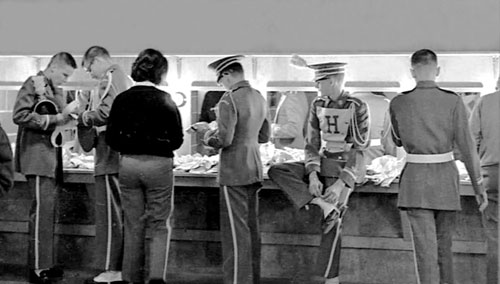
For thee great
years, wearing cumbersome uniforms complete with decorative hats
and shiny white spats, I marched with the band onto football fields
and in community parades. It was all the more worth the effort to
have a beaming Walter Nechoda proudly marching along side us.
Familiar goose
bumps flooded my arms as I marched among strong drummers
eagerly pounding out syncopated street beats marching left foot
right foot in time with the intoxicating rhythm. We played like we
were the best, marched strong and proud with crashing cymbals raised
high, bass drums thundering, and snare drums together beating out the
familiar Hinsdale signature "street beat" marching routine
in perfect synchronization.
Little did I
know back then that music would so saturate my soul to define what
would be one of the most richly rewarding experiences of my life.
ENTER SCOT
ROBINSON...
Though we first met in
nursery school, Scot and I attended different grade schools. It was
in the seventh grade Junior High band that Scot and I were
reacquainted in 1962. The following year in 8th grade,
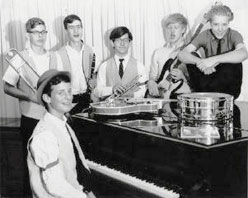
we formed “The Imperials” Dixieland band with classmates, Barry
Kopecky (tenor sax), Jay Kusler (string bass), Brad McDonald
(clarinet), Chris Church (trombone), and Steve Meador (piano).
Stan Meador,
Steve's father, was a professional musician who led our rehearsals
in the basement of their home. The basement family room had
everything we needed... an upright piano, music stands, chairs, and
a huge library of sheet music. It was great fun for us to have
Stan as our band director. And I suspect even more fun for
Stan to have young musicians eager to learn from him.
Scot's dad was a professional designer and
made beautiful signs for "The Imperials" on blue boards with old
English script gold leaf lettering and also fabricated matching
music stands similar to those used by the "big bands" from the
30's and 40's.
One Saturday
morning Stan Meador drove us all downtown to "Kale Uniforms" on
Roosevelt Road in Chicago where we bought used white tuxedo jackets
to wear when we played at formal gigs. Our moms got together
and sewed red and white striped vests that we wore with white shirts
and red garters on our sleeves and black derby hats when playing at casual engagements.
For two short years
in our youth, we enjoyed playing old standards and Dixieland
classics at local ice cream socials and Eight Grade graduations.
While still in eighth grade, the Imperials played one night at an
event in the gymnasium auditorium at the old junior high where we
attended school. It was fun for us to provide musical
entertainment appearing before several hundred of our peers, their parents,
and our teachers.
The following day
in Mrs. Kissel's English class I was surprised to have her
compliment me on my musical talent after hearing the Imperials the
night before. Academically, I never got good grades and always
struggled to just barely get by. Mrs. Kissel's praise greatly
boosted my pride that day and encouraged me to continue pursuing
music.
Scot took up guitar
upon entering high school shortly after The Beatles stormed our
lives. At that time the electric guitar was yet still a new,
intriguing, unconventional musical instrument oddity born from the now
legendary Les Paul. Scot couldn’t help but yield to the call and
shortly mastered the guitar.
Robin Robinson was
enormously proud of his first born son Scot. Despite financial
hardship, for Scot’s 16th birthday, Robin managed to buy
Scot a beautiful Gretch Chet Atkin’s hollow body electric guitar and
a Vox Royal Guardsman amp. This was serious professional grade
equipment. Putting it in perspective, the cost at the time was
equal to three or four mortgage payments.
Scot’s delight
wrestled with pride for his father’s joy in making a gift of those
beautiful instruments. He graciously and proudly received the gifts
fully aware of the great sacrifice required to make it all happen.
I get teary having known them both so well.
Scot and I
disbanded the Imperials in favor of playing rock and roll music
and formed "The Viscounts" that later evolved into "The Changing
Tymes". We played at local "battle of the bands" contests,
dances, and concerts while in our early teens. Then we met
Chris Rhodes and formed the 1010 Balloon Activities Group.

Back Home
|